

Ever wonder how some websites always show up first when you search for something on Google, while others barely show up at all? The answer usually comes down to one thing: SEO.
If you've ever asked "what is SEO?" and felt a little lost by the answers you found, you're not alone. A lot of explanations jump straight into technical jargon before explaining the basics. This guide takes a different approach. It's written for real beginners business owners, bloggers, marketers, and anyone with a website who wants to understand search engine optimization without needing a computer science degree.
By the end of this article, you'll know what SEO actually is, how search engines decide what to show, why SEO matters so much for your website, and what simple steps you can take today to start improving your rankings. Let's get into it.
What Is SEO?
SEO stands for Search Engine Optimization. In plain terms, it's the practice of improving your website so that it shows up higher in search results when people look for things related to your business, products, or content.
Think of SEO as the process of speaking the same language as Google, Bing, and other search engines. When you optimize your site correctly, search engines can understand what your pages are about and decide whether they deserve to appear for a particular search.
Here's a simple way to picture it. Imagine a massive library with billions of books, but no librarian and no card catalog. Search engines act like that librarian. They read through content, figure out what each page covers, and then hand people the most relevant books when they ask a question. SEO is how you make sure your "book" gets picked and placed on the front shelf instead of buried in the back.
This beginner's guide to SEO will walk you through exactly how that process works.
How Search Engines Work
Before learning how SEO works, it helps to understand what search engines are actually doing behind the scenes. There are three main steps involved.
-
Crawling – Search engines use automated programs called bots (or spiders) to scan the web and discover pages. These bots follow links from one page to another, constantly finding new or updated content.
-
Indexing – Once a page is found, the search engine studies it and stores the information in a giant database called an index. This is like adding a new book to that massive digital library.
-
Ranking – When someone types a search query, the search engine scans its index and decides which pages best answer that question. It then ranks them in order, from most relevant to least relevant.
Search engines rely on hundreds of ranking factors to make that decision. Things like page content, site speed, mobile-friendliness, and how trustworthy a website appears. You don't need to memorize every factor. You just need to understand that search engines are trying to give users the best possible answer, and your job with SEO is to prove that your page deserves that spot.
Why SEO Is Important
Some business owners assume paid ads are the only way to get noticed online. But organic search. The free listings that appear because of relevance, not payment — still drives a huge share of website traffic across almost every industry.
Here's why SEO deserves your attention:
-
It builds long-term traffic. Unlike ads that stop working the moment you stop paying, good SEO keeps bringing visitors long after the work is done.
-
It builds trust. People tend to trust organic results more than ads. Ranking high naturally signals credibility.
-
It's cost-effective. SEO takes time and effort, but it doesn't require an ongoing ad budget to keep showing up.
-
It targets people actively searching. SEO puts your website in front of people who are already looking for what you offer, which usually leads to better conversion rates.
Simply put, if your ideal customers are searching for your product or service, SEO helps make sure they find you instead of your competitor.
Types of SEO
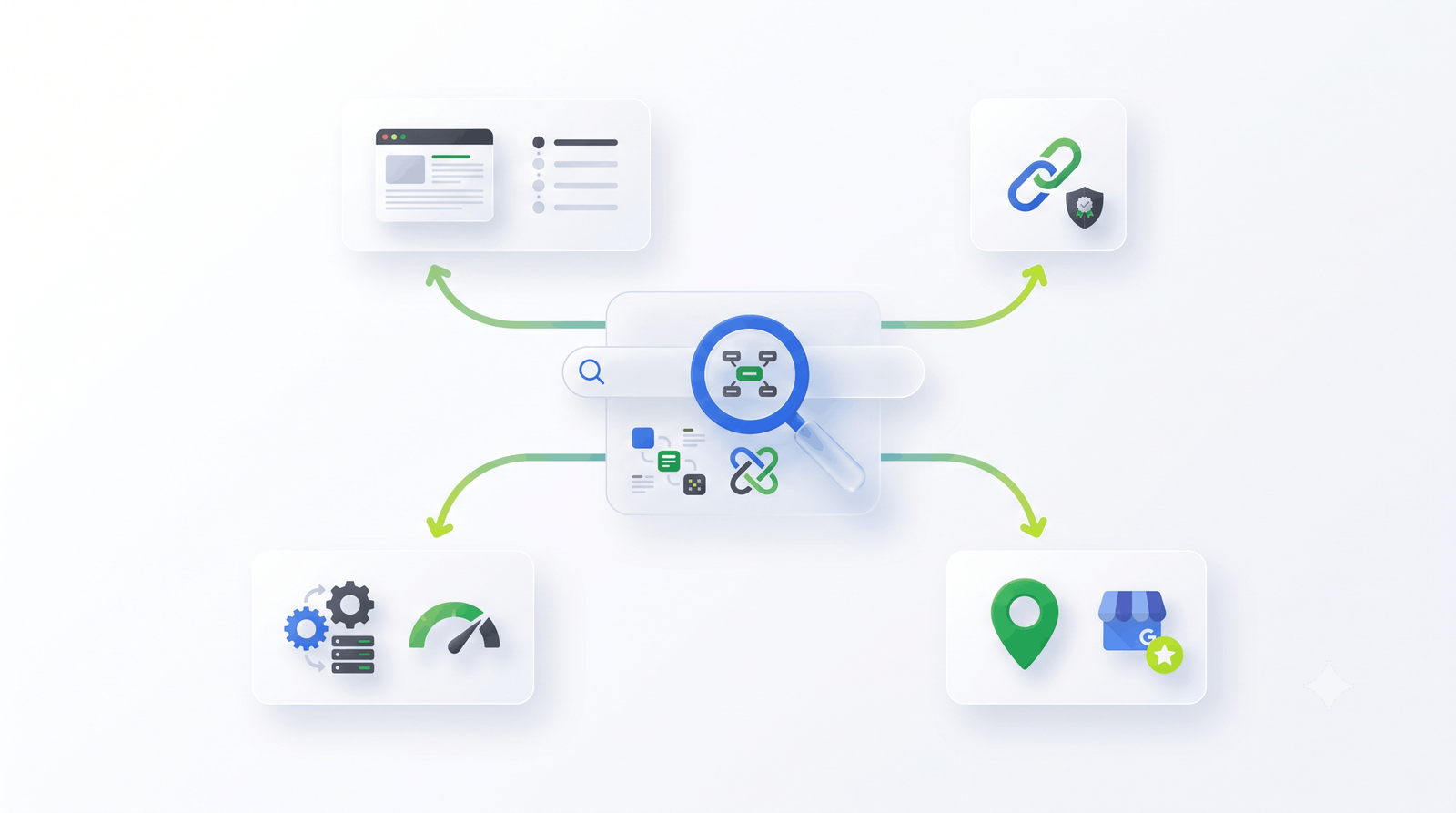
SEO isn't one single technique it's a mix of different strategies working together. Let's break down the four main types.
On-Page SEO
On-page SEO refers to everything you can control directly on your website. This includes:
-
Writing quality, helpful content that answers what people are searching for
-
Using keywords naturally in titles, headings, and body text
-
Writing clear meta titles and descriptions
-
Organizing content with proper headings (H1, H2, H3)
-
Adding descriptive image alt text
-
Linking to other relevant pages on your own site
Good on-page SEO makes it easy for both readers and search engines to understand your content.
Off-Page SEO
Off-page SEO covers actions taken outside your own website that affect your rankings. The biggest piece of this is backlinks — links from other websites pointing to yours. When trustworthy sites link to your content, it acts like a vote of confidence in the eyes of search engines.
Off-page SEO also includes things like brand mentions, social sharing, and guest posting on reputable sites in your industry.
Technical SEO
Technical SEO focuses on the backend health of your website. Even the best content won't rank well if search engines struggle to crawl or load your site. Technical SEO includes:
-
Site speed and page loading times
-
Mobile-friendliness
-
Secure connections (HTTPS)
-
Clean URL structure
-
XML sitemaps and robots.txt files
-
Fixing broken links and duplicate content
Technical SEO isn't the most exciting part of the process, but it lays the foundation for everything else that depends on it
Local SEO
Local SEO is all about helping nearby customers find your business, especially useful for shops, restaurants, clinics, and service providers. It involves:
-
Setting up and optimizing a Google Business Profile
-
Collecting and responding to customer reviews
Comments
Join the conversation. New comments are reviewed before they appear.
No comments yet. Be the first to share your thoughts.
Leave a comment
Tell us what you think about this article.